Wendall Berry's first tip to eating more responsibly was to try and grow as much of your own food as you can. I completely agree with this and I think this is the best way to be more responsible about the food you eat. The only way you can know exactly what is in your food is if you grow it yourself. Berry also makes the point that growing your own food is a great way to learn how the energy cycle of food works. While I don't grow any of the food that I eat, I think Berry makes some great points that make we want to try growing my own food in the future.
Berry's second tip was to prepare your own food. Cooking your own meal is a great way to eat responsibly and just like Berry says, it allows you to eat more cheaply. Once last year, I decided that I was going to make chili. I went to the store and bought all the ingredients which added up to be about twenty five dollars (a little pricey) but the chili lasted me about a week. Another bonus was that I had control of how much of each ingredient I put in the chili. While I prepare some of my own food, In the future I would love to be able to prepare most of my own food. However, living in dorms on a college campus makes that a little hard.
Berry's third point was to learn about the origins of the food you buy and to buy local food. Eating locally grown food is pretty new to me, but so far I support it. I would love to one day be able to buy only fresh, locally grown fruits and vegetables. My only critique of locally grown food is that buying it can sometimes be more expensive than the non-local option, which as a college student is usually the option I have go with.
His fourth tip was to buy food directly from a local farmer. I think that doing this leads to even more responsible eating than simply buying food from a store that is marked "locally grown". In class, I heard a statistic that fresh food loses 30% of its vitamins and minerals if it isn't eaten 3 days after it was picked. If you're buying food from the store, chances are it isn't going to be as fresh as if you buy it straight from the farmer who grew it. If I had the option, I would buy fresh fruits and vegetables from a farmer, however I don't know any local farmers. Also, living on a college campus makes cooking your own meals a bit hard.
Wendall Berry's fifth tip is the only one I don't agree with. It's one thing to be informed about what goes into the food that you eat, but I do not think that knowing about the economy and technology of industrial food production makes you any more of a responsible eater.
Berry's sixth and seventh tip can be discussed together. Learning about farming and gardening as well as the species of food that you eat can be very important if you want to be a more responsible eater. How can one strive to eat only the healthiest and freshest fruits and vegetables if they don't know anything about how they were grown? I don't know much about farming or species of foods, but I'm hoping that working in the Castanea garden on the UNCA campus will help me learn more.
I think that Food Justice was a great passage to compare to "The Pleasures of Eating". While both promote the idea of eating fresh, locally grown food to be more responsible about eating, one passage was much more realistic than the other. While Berry focuses on what people can do to eat more responsibly, he neglects the fact that everyone doesn't have access to fresh food and some people can't afford it. Gottlieb and Joshi focus on the reality of the economy of food. While there are many opportunities to eat locally and know your farmer in places like Asheville, in contrast people don't get the same options in big cities like Chicago and New York City. In Food Justice, Gottlieb and Joshi bring up great points about the struggle between responsible eating and the economy of food.
Sunday, September 27, 2015

Thursday, September 24, 2015
Locally Grown Food in Asheville
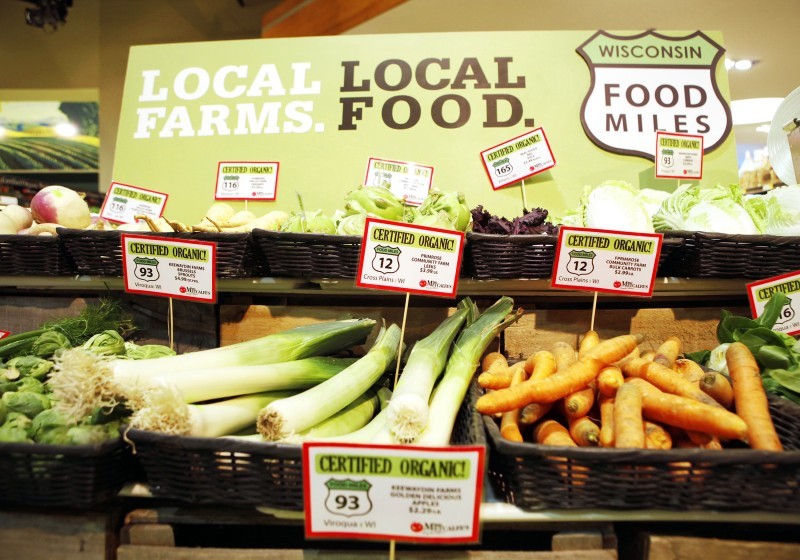
The image I chose to represent food in Asheville is a picture of the vegetable section at a supermarket where everything is locally grown and organic. I chose this picture because locally grown food is very popular in Asheville and is very important to many residents of Asheville. A lot of people in Asheville like to know where their food comes from and they would rather support a local farm than a large-scale food company.
Before I moved here, locally grown food wasn't very important to me. I had always figured that all vegetables and fruits tasted the same regardless of where they were grown. It wasn't until I went to Farm Burger downtown that I realized how much of a difference there is between the taste of locally grown food and food not grown locally.

Before I moved here, locally grown food wasn't very important to me. I had always figured that all vegetables and fruits tasted the same regardless of where they were grown. It wasn't until I went to Farm Burger downtown that I realized how much of a difference there is between the taste of locally grown food and food not grown locally.
Sunday, September 20, 2015
Service Learning Reflection
For my service learning, I work in the Castanea garden on Fridays from 1 to 3. During my time there, I have completed a variety of tasks. For instance, two weeks ago I weeded and spread soil, and this week I worked on composting. So far, I'm really enjoying my work in the garden. I like working outside and doing things with my hands. I also love doing something that benefits the community.

I've learned a lot about agriculture and farming from working in the garden. For example, on Friday I tried a fruit that I had never heard of before, and I learned the difference between organic compost and food compost. While it is true that If I were researching gardening instead of working in a garden, I would probably learn a lot, I wouldn't have gained the same knowledge through experience. I never really thought about the fact people grow the fruits and vegetables I purchase. A lot of unseen effort goes into all grown food and I've never really given that much thought. After working in the Castanea garden, I've learned the importance of local growers.
The Castanea garden community is an eco-friendly garden, which means everything that happens there takes into account how the environment is being effected. While we were making the compost container, the garden supervisor insisted on using screws instead of nails because screws can be re-used and nails can't. Finding ways to reduce waste on campus is another goal of the garden. For example, all of the compost that we use in the garden is made from leftover food on campus.
Since I started taking this english class and started working in the Castanea garden, I've become more interested in agriculture and farming. Even though I only have to work in the garden for 20 hours this semester, I'm thinking about continuing my work in the garden next semester and maybe even next year. I think working in the garden is giving me a greater appreciation for food and the way food is grown. I am very grateful for this opportunity to work in a community garden.
Friday, August 28, 2015
Eating the Hyphen
In the first piece, "Eating the Hyphen" I really liked the way Lily Wong went about getting her point across. She explained her strange process of eating dumplings to make a point about what food means to her in Chinese-American culture. Her point was that you don't have to try and "act" like a certain person to be a certain ethnicity. For example, eating dumplings with ketchup like an "American" shouldn't make Lily Wong any less Chinese. I also really enjoyed Wong's rhetoric and how the piece was written. The tone of the first half of the piece was very humorous and the second part was a bit humorous, but she got a good point across at the same time.
"Reclaiming True Grits" had a purpose very similar to that of the first piece, but a bit different. While "Reclaiming True Grits" was also about the food of a certain culture, it dealt more with the cultural issues and stigmas surrounding the food. In this piece, Bryant Terry talked a lot about the how people perceive soul food as being unhealthy, when the only unhealthy soul food is instant soul food. Bryant Terry also talked about how unhealthy eating habits have been romanticized and normalized in cultures. I totally agree with this. Even though these days everybody is obsessed with being skinny and fit, the way most of the world views food is distorted. For example, look at the size of the average plate. These days, it's normal for people to eat way more food than they need to.
The writing style of "Reclaiming True Grits" was similar to that of "Eating the Hyphen", but it was much more serious. Bryant Terry also included a recipe for a traditional dish of his culture but unlike Wong, he uses history to support his argument.
Tuesday, August 25, 2015
College Food Focus Reflection
For me, eating exclusively in a cafeteria is nothing new. Before UNCA, I attended The School of the Arts in Winston Salem. Since I lived on campus there, I am pretty accustomed to eating in a cafeteria but what is new for me is not consistently being active. At The School of the Arts, I majored in ballet so I was "working out" for at least 3 hours a day everyday and didn't have to worry so much about the kind of food I ate. This is the first time in almost my whole life that I have complete freedom of what I can eat but am not constantly active.
So far, I'm not the best at making healthy food decisions at college. My diet the last few days has consisted mostly of Chinese food, burritos and chips. I think that balancing my schedule has played a big part in my diet. In college, (at least in my experience so far) you don't always have time to sit down for an hour and have lunch. A lot of the time I'm in a hurry, so I go for the quickest thing I can find like a burrito or left over Chinese food. I'm sure I'm not the only student with this problem because I see people every day walking around campus eating hot pockets or pop tarts.
When I do have time to sit down and have a good meal, I'm not necessarily very good at eating healthy. I tend to go with the foods I'm most comfortable with like sandwiches and pizza, instead of some of the healthier, "riskier" options. Unlike Camille Kingsolver, I'm not very conscientious of the origins of the food I eat. I rarely know where my food comes from or when it is in season, much like the people Camille Kingsolver describes in her writing. However, in the two weeks I've been at UNCA, I think I have gotten a little better at thinking about the food I eat more. For example, I'm starting to read descriptions of the food and informative signs in the cafeteria. Who knows, in two more weeks I could be seeking out locally grown food!
So far, I'm not the best at making healthy food decisions at college. My diet the last few days has consisted mostly of Chinese food, burritos and chips. I think that balancing my schedule has played a big part in my diet. In college, (at least in my experience so far) you don't always have time to sit down for an hour and have lunch. A lot of the time I'm in a hurry, so I go for the quickest thing I can find like a burrito or left over Chinese food. I'm sure I'm not the only student with this problem because I see people every day walking around campus eating hot pockets or pop tarts.
When I do have time to sit down and have a good meal, I'm not necessarily very good at eating healthy. I tend to go with the foods I'm most comfortable with like sandwiches and pizza, instead of some of the healthier, "riskier" options. Unlike Camille Kingsolver, I'm not very conscientious of the origins of the food I eat. I rarely know where my food comes from or when it is in season, much like the people Camille Kingsolver describes in her writing. However, in the two weeks I've been at UNCA, I think I have gotten a little better at thinking about the food I eat more. For example, I'm starting to read descriptions of the food and informative signs in the cafeteria. Who knows, in two more weeks I could be seeking out locally grown food!
Sunday, August 23, 2015
Eating Disorders
The first piece, "Her Chee-to Heart" was very entertaining to read but I didn't really understand the purpose of it past to of entertain the reader. I think the authors target audience was very large, being anyone who had eaten junk foods as a kid (or as an adult). The authors knowledge of her target audience is used as a form of rhetoric, because it lets the reader connect through experience with what the author is saying. For example, the author writes, "Yodels, Twinkies, Hostess Snowballs. They make people nostalgic for elementary school, those wonderful years when we were advised to eat beef and pork." (McCorkle, 32) Overall I enjoyed this piece. I thought it was pretty entertaining, but since I had just eaten a large meal before reading it, all the talk about fatty foods made me feel a little gross.
The second article on the other hand, was a polar opposite of the first one. This second article, "Not Just a White Girl Thing" was meant to inform the reader of the popular misconception that only rich, perfectionist white girls have eating disorders. The article explains in detail how women, and men of all different ethnicities have eating disorders and how an eating disorder does not only mean bulimia.
What I really appreciated about this article is how Susan Bordo talked about culture and media being the ones to blame for many young women's eating disorders instead of unhealthy food and big chain restaurants. One of the reasons I don't usually like to read about eating disorders is that so many people blame America's problem with eating on big companies and chain restaurants. While I think chain restaurants and big companies have a bad influence on American's eating habits, I heavily believe in moderation, much like Bordo and I don't think big food companies should hold so much control over us. Bordo brings up great points about the media, such as the story of the women in Fiji who were introduced to American television and developed eating disorders. Bordo also has statistics that heavily support her points, such as, "57% of girls have fasted, used food substitutes or smoked cigarettes to lose weight" (Bordo, 274).
Another thing I appreciated about this piece was her recognition of men with eating disorders. Coming from the ballet community, I know a lot of people with eating disorders, many of which are male ballet dancers. While it's a fact that there are more women than men who have eating disorders, I think some people forget that men are targeted by the media to be skinny and fit as well.
I think Susan Bordo did a great job with her article "Not Just a White Girl Thing". She used statistics about eating disorders as rhetoric, which I think was very effective and she talked about the media, which is not always given the blame for eating disorders.
The second article on the other hand, was a polar opposite of the first one. This second article, "Not Just a White Girl Thing" was meant to inform the reader of the popular misconception that only rich, perfectionist white girls have eating disorders. The article explains in detail how women, and men of all different ethnicities have eating disorders and how an eating disorder does not only mean bulimia.
What I really appreciated about this article is how Susan Bordo talked about culture and media being the ones to blame for many young women's eating disorders instead of unhealthy food and big chain restaurants. One of the reasons I don't usually like to read about eating disorders is that so many people blame America's problem with eating on big companies and chain restaurants. While I think chain restaurants and big companies have a bad influence on American's eating habits, I heavily believe in moderation, much like Bordo and I don't think big food companies should hold so much control over us. Bordo brings up great points about the media, such as the story of the women in Fiji who were introduced to American television and developed eating disorders. Bordo also has statistics that heavily support her points, such as, "57% of girls have fasted, used food substitutes or smoked cigarettes to lose weight" (Bordo, 274).
Another thing I appreciated about this piece was her recognition of men with eating disorders. Coming from the ballet community, I know a lot of people with eating disorders, many of which are male ballet dancers. While it's a fact that there are more women than men who have eating disorders, I think some people forget that men are targeted by the media to be skinny and fit as well.
I think Susan Bordo did a great job with her article "Not Just a White Girl Thing". She used statistics about eating disorders as rhetoric, which I think was very effective and she talked about the media, which is not always given the blame for eating disorders.
Thursday, August 20, 2015
What The World Eats
The thing that shocked me the most about this passage was the ratio of food to family members in certain countries. For example, an American family of four could spend nearly 350 United States dollars a week on food while an Egyptian family of twelve could spend close to 70 United States dollars a week on food. It didn't take very long for me to find a pattern in food spending across the entire world. There was a British family of four who spent 250 United States dollars on food a week, a French family of four who spent 400 United States dollars a week on food and a Norwegian family of five who spent 370 United States dollars a week on food.
I realized that America, along with most European countries spent more money per week on food than other countries. Pretty shocking? Right? I didn't think so either, but I wanted to know why, so I decided to research the subject for an answer.
After pages of google results and news article after news article I had a thought. In countries such as Chad, Egypt and Ecuador, most families ate fruits and vegetables while American and European families ate mostly packaged food. Could this mean that certain families were growing their own food while American and European families were just buying their food at a store? I looked up the decline of the small American family farm and found out that there are nearly 4 million less farms in America than there were 100 years ago. This lead me to believe that most Americans and Europeans are too dependent on big industries for their food. I think that if more people grew their own food or bought food locally they would probably be healthier, spend less money, and support more local business.
I realized that America, along with most European countries spent more money per week on food than other countries. Pretty shocking? Right? I didn't think so either, but I wanted to know why, so I decided to research the subject for an answer.
After pages of google results and news article after news article I had a thought. In countries such as Chad, Egypt and Ecuador, most families ate fruits and vegetables while American and European families ate mostly packaged food. Could this mean that certain families were growing their own food while American and European families were just buying their food at a store? I looked up the decline of the small American family farm and found out that there are nearly 4 million less farms in America than there were 100 years ago. This lead me to believe that most Americans and Europeans are too dependent on big industries for their food. I think that if more people grew their own food or bought food locally they would probably be healthier, spend less money, and support more local business.
Subscribe to:
Posts (Atom)